Juba Queens FC’s early coaching change has raised a wider question about how new football clubs should build for success, after the Nile Divas parted ways with members of their technical staff just days after their first official match.
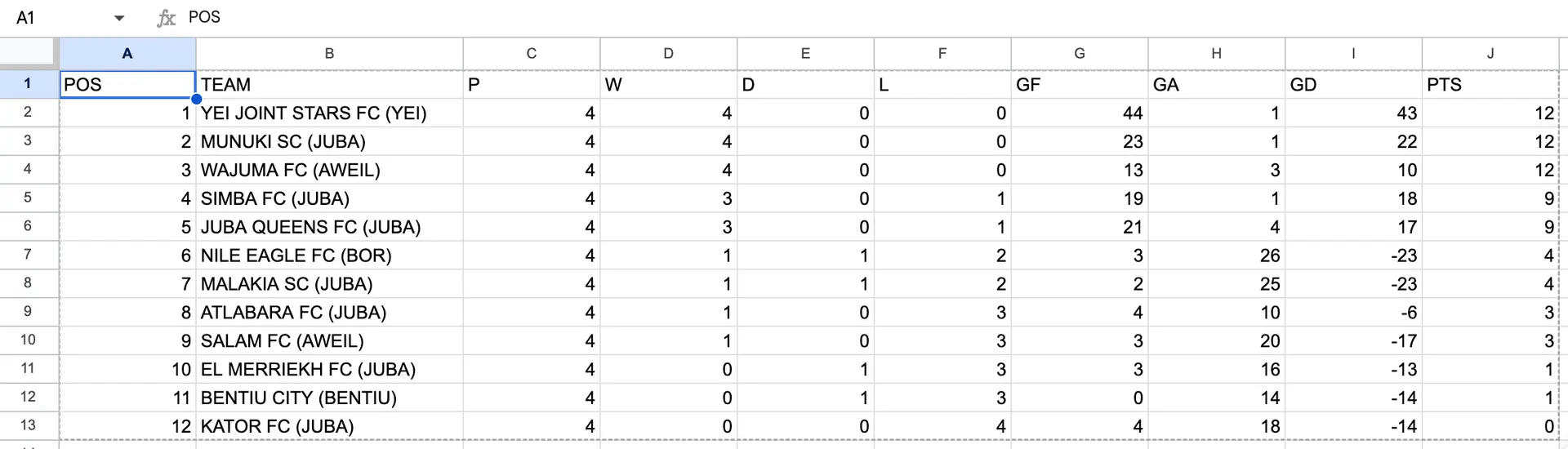
The newly established Juba-based club suffered a 4-1 defeat to Yei Joint Stars in their opening competitive fixture before announcing that they had mutually agreed to part ways with members of the technical team.
However, the timing has placed the focus not only on the result, but also on the expectations placed on a new club and its coaching staff.
A short-lived coaching project
Rina Hope Thomas was appointed head coach of Juba Queens on September 1, 2026, with the club beginning training on the same day.
Emmanuel Drichi was appointed assistant coach three days later as the club continued preparations for its debut campaign.
Juba Queens played their first friendly on September 13, recording an emphatic 6-0 victory over Jamus Academy.
Their first official match presented a significantly tougher examination.
The Nile Divas were beaten 4-1 by Yei Joint Stars, one of the most established sides in South Sudanese women's football.
Days later, Juba Queens announced the departure of members of their technical staff.
The club did not publicly state that the defeat was the reason for the decision.
Good players do not guarantee instant success
Juba Queens assembled a squad with promising players, but individual quality alone does not guarantee immediate success.
A new team must develop chemistry, tactical understanding and a collective identity.
Players need time to understand their coach's methods, build partnerships and learn how to respond to different situations during matches.
The contrast between Juba Queens' 6-0 friendly win and their 4-1 competitive defeat also illustrates the difference between preparation and competition.
A strong friendly result can provide encouragement, but competitive football offers a different level of pressure and intensity.
Yei Joint Stars provide important context
Juba Queens' first official opponent also deserves consideration.
Yei Joint Stars are an established force in South Sudanese women's football, with significant domestic and regional experience.
The club has won the South Sudan Women's Cup and League several times and has represented the country in all six CAF Women's Champions League CECAFA qualifying campaigns.
Yei Joint Stars also won the 2025-26 South Sudan Women's Cup.
Their recent regional progress is another indication of their experience.
At the 2026 CAF Women's Champions League CECAFA qualifiers, Yei Joint Stars reached the semi-finals for the first time in their sixth appearance.
They had previously failed to progress beyond the group stage in their first five campaigns.
For Juba Queens, therefore, the opening competitive fixture was against a side with considerably more experience at both domestic and regional level.
How long should a new club give its coach?
There is no universal timeframe for judging a coach.
The answer depends on the club's objectives, the quality of the squad, the competition, available resources and the expectations established when the coach was appointed.
For a newly formed club, the early stages should not necessarily be judged by results alone.
Management can also examine whether players are improving, whether the team has a clear tactical structure, whether training standards are being maintained and whether the squad is developing a recognisable identity.
Results become increasingly significant as more matches are played.
One defeat is an isolated result.
Repeated weaknesses can become evidence of a wider problem.
When does a coaching decision become easier to justify?
A club can make an early coaching change for many reasons, including differences over tactical philosophy, training standards, discipline, player management or the overall direction of the project.
There may also be internal circumstances that are not publicly disclosed.
In Juba Queens' case, the official statement said the club had mutually agreed to part ways with members of the technical staff.
No detailed explanation was provided.
It would therefore be premature to conclude that the 4-1 defeat alone led to the decision.
What should success mean for Juba Queens?
For a new club, success should be defined before results begin to shape the narrative.
If the immediate objective is to establish a competitive team, management may need to assess progress differently from a club whose stated target is to win a championship in its first season.
Results remain central to football.
But player development, tactical organisation, squad cohesion, professionalism and the creation of a sustainable football structure are also important indicators of progress.
Yei Joint Stars' own regional history demonstrates that development does not always happen immediately.
The club had five previous CECAFA qualifying campaigns without reaching the knockout stage before advancing to the semi-finals in its sixth appearance in 2026.
That does not mean Juba Queens should wait years before demanding results.
It does show that building a competitive football institution can take time.
The next chapter for the Nile Divas
Juba Queens now face an important decision as they look to appoint or establish their next technical setup.
The key questions extend beyond the identity of the next coach.
What does the club want to achieve?
What style of football does it want to play?
What resources will be available?
What targets will the coach be given?
And how long will management allow the project to develop before making another assessment?
Those questions could ultimately prove more important than the result of one match.
The 4-1 defeat to Yei Joint Stars is the first competitive result in Juba Queens' history.
The real test now is how the Nile Divas use that experience to build the next stage of their project.